kith
A career mentorship app that connects ambitious professionals with the right guide — at the right time.
Mobile UX
iOS
0 → 1
Career Tech
Summer 2025
KITH is a 0→1 product design project exploring how to remove friction from the mentor-mentee relationship — from discovery through ongoing accountability.
End-to-end: research, IA, wireframes, design system, hi-fi UI
Discovery → Research → Design → Prototype → Test
Prototyping, user flows, usability testing
iPhone-first, designed to HIG principles
Most professionals know they need a mentor — but don't know how to find one, approach one, or sustain the relationship once it starts.
Existing platforms are either gated by expensive programs, built for job hunting, or too passive to create real accountability. There's a gap between LinkedIn and actual career growth.
I conducted 45-minute interviews with early-career professionals (1–4 years exp.) and experienced mentors. Participants were recruited across design, engineering, and marketing fields.
Users know who they'd like to learn from — but feel they have no credible reason to reach out without a warm introduction.
Most informal mentorships fade because there's no shared infrastructure — it all lives in email threads and "let's sync soon" messages.
Users rely heavily on social proof — mutual connections, verified credentials, and past mentee reviews before making contact.
"I have so many questions but nowhere to ask them where someone actually knows my context."
"I can find articles about career switching all day. What I need is someone who's actually done it."
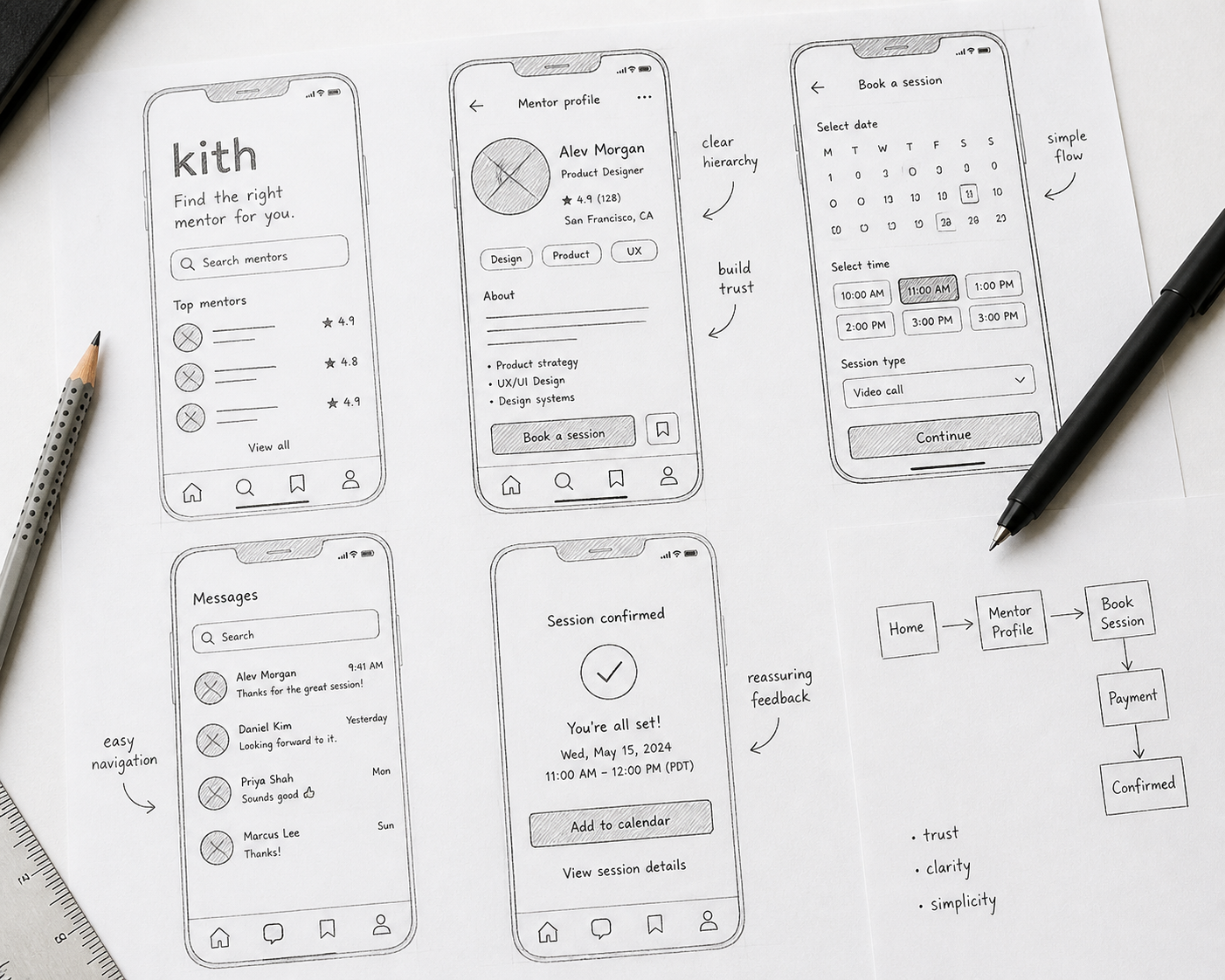
8 key screens mapped before any visual design decisions were made.
On track · Est. 8 weeks left
Users successfully booked a first session with a new mentor in under 3 minutes during usability testing.
Mentor profile design scored 4.6/5 on perceived credibility — up from 2.9 in the initial wireframe test.
8 out of 10 test participants said they would use KITH over existing options for career mentorship.
Users cared more about a mentor's career narrative (what transitions they'd made) than their job title. Surface the story, not just the status.
Any extra step in booking killed intent. The calendar flow went through 4 iterations before reaching under 3-tap booking — worth every round.
The dashboard's goal progress ring was consistently cited as the feature users most wanted to return to. Accountability by design.
Users spent more time on the profile screen than any other. The design work done here had the highest ROI on overall conversion confidence.